
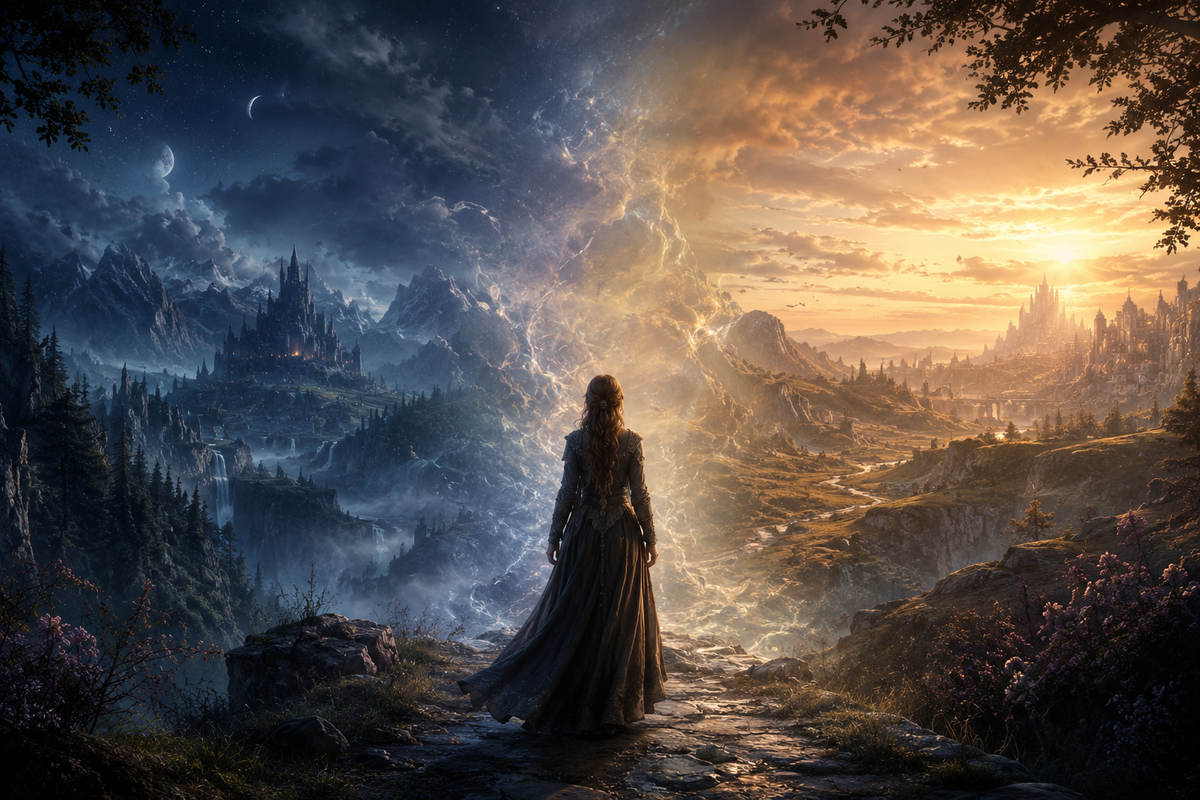

Where We Belong
Why I Write About the Spaces In Between
8 Sept 2026
The themes I write about were not initially planned.
I didn't sit down before writing In-Between and decide that I wanted to explore identity, belonging, and liminality. In fact, it was only after naming the world of my first novel that I began to recognise the pattern.
The more I thought about it, the more it made sense.
Because I have spent much of my life somewhere in between.
Never Quite One Thing
I never completely felt as though I fitted in.
I know that sounds like something every writer says. Perhaps it is one of the reasons so many of us disappear into books in the first place.
As a child, I found refuge there. I identified with the unlikely heroes, the chosen ones who came from nothing, the characters nobody noticed until circumstances demanded that they rise.
In the real world, I often tried to do the opposite.
I was bullied. I struggled with an eating disorder. I learnt to make myself smaller and tried to fit into boxes other people had created for me.
I was never quite French enough. Never quite Canadian enough. I belonged to both countries and, somehow, completely to neither.
I was always somewhere in between.
Perhaps that is why the question at the heart of so much of my writing is deceptively simple:
Where do we belong?
The Fantasy of Belonging
Belonging is one of the most fundamental things we search for.
We look for our people. Our family. Our village. The friendships in which we don't have to perform. The relationships in which we can finally exhale and become more fully ourselves.
For me, building my own family has changed my understanding of that enormously. There is something liberating about seeing myself reflected in my children's eyes and knowing that, to them, I simply belong. My relationship with my husband also taught me that love does not have to require making yourself smaller to keep it.
Perhaps this is one reason fantasy has such an enduring appeal.
Fantasy has always been filled with found families, outsiders discovering their strength, ordinary people finding extraordinary purpose, and characters searching for somewhere—or someone—to call home.
It creates worlds in which those who feel invisible here can imagine themselves becoming heroes somewhere else.
And although those worlds may contain monsters, magic and impossible dangers, the emotional struggles beneath them are often remarkably familiar.
Who am I?
Who decides who I am?
Who are the people with whom I can finally become myself?
Where do I belong?
Writing about the In-Between
Those questions have become the foundation of my writing.
In-Between 2 explores them quite literally.
Four people leave Earth and arrive in a world that already has stories about who they are supposed to be. They are told they are the reincarnations of ancient Guardians—the Second Children—but their identities are interpreted, celebrated, feared, manipulated and rejected by different people.
What happens when the person you believe yourself to be conflicts with the symbol everyone else needs you to become?
What happens when other people tell your story for you?
And can you still decide who you are once the world has decided first?
Those questions become even more important as The In-Between Saga progresses.
My other novel, Soul-Threader, approaches identity differently. It explores memory, soulmates, identity, and the difficult choice to love oneself.
Different worlds. Different characters. Different stories.
But I have realised that I keep returning to the same threshold.
The space between who we are and who we are becoming.
Why Fantasy Matters in Uncertain Times
I also think there is a reason we turn towards fantasy when the real world feels uncertain.
Epic fantasy can take enormous, complicated questions and give them shape.
Wars become battles we can witness. Oppression has a face. Characters are given choices at moments when everything appears hopeless. Evil may be complicated and heroes deeply flawed, but stories allow us to imagine that action still matters.
They give us somewhere to put our fear.
More importantly, they give us somewhere to put our hope.
Perhaps that is why I have never understood the idea that fantasy is somehow less serious because it deals in invented worlds.
Fantasy can talk about prejudice without writing a history textbook. It can explore power through an emperor, identity through magic, political extremism through prophecy, grief through immortality, or belonging through a group of strangers forced to become a family.
The dragons aren't real (oh, if only).
The emotions are.
Beyond What We Can See
There is another reason I am drawn to in-between places.
I have always been fascinated by the things we cannot quite explain: signs, coincidences, intuition, spirituality, the possibility of something beyond what we can see.
The veil between worlds.
The idea that perhaps we are more connected—to one another, to the past, to the universe—than we understand.
There is comfort for me in that possibility because connection is, in its own way, another form of belonging.
If we are all connected, perhaps none of us can ever be entirely outside.
Maybe then... we all belong.
Something powerful in a world that increasingly wants to divide us.
Still Becoming
Becoming yourself isn't something that happens once.
I am still doing it.
I still have to remind myself that I am allowed to embrace parts of myself I once tried to reject. And now, as a mother, I am navigating another in-between space: loving motherhood fiercely without allowing the identity of "mother" to swallow every other version of me.
Writer. Wife. Mother. French. Canadian. Ambitious. Exhausted. Creative. Organised. Contradictory.
Perhaps belonging isn't about finally choosing one box.
Perhaps it is about realising you never needed the box at all.
As I work on the second book in The In-Between Saga, I am much more conscious of these themes than I was when I began.
And as I continue querying Soul-Threader, hoping that one day it will find its own home and its own readers, I see the same questions running beneath that story too.
I don't know exactly what I will write ten years from now.
But I suspect I will always be interested in thresholds.
In fractures.
In the people caught between different versions of themselves.
And, ultimately, in that universal search for somewhere we can finally say:
I belong here.
Comments
Leave a comment
