




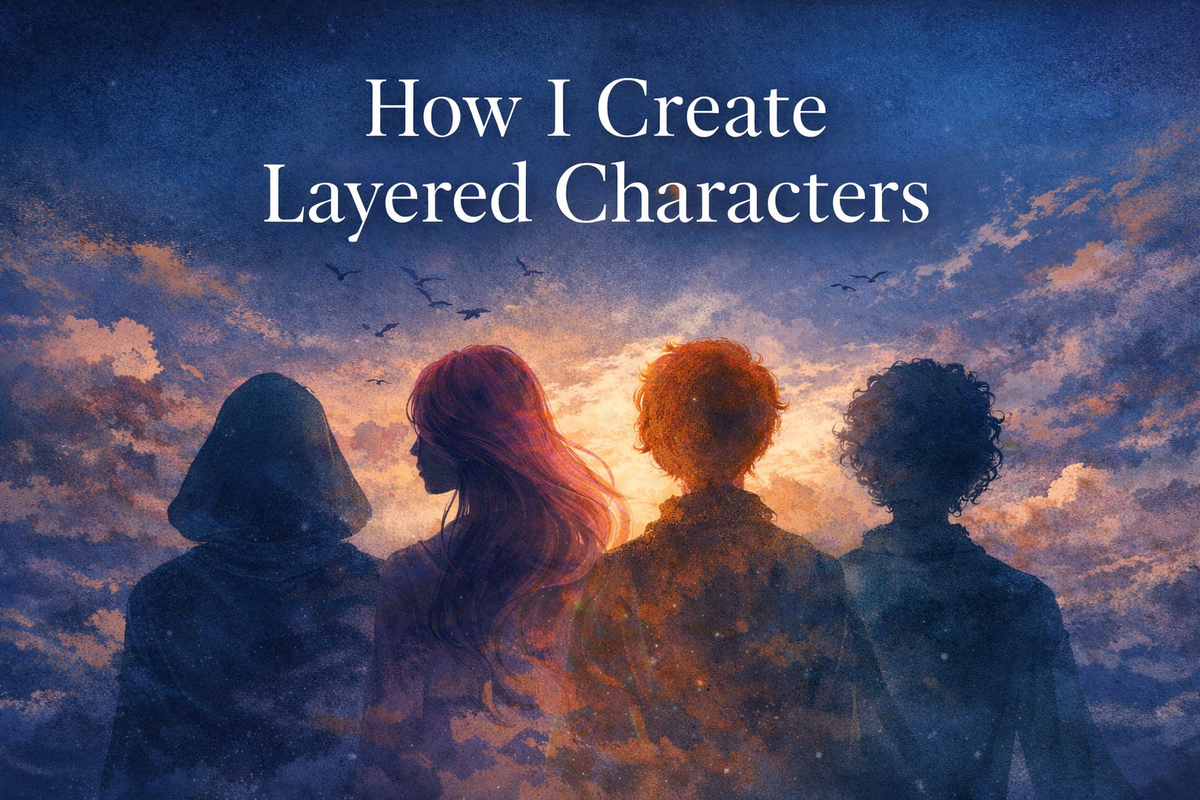

How I Create Layered Characters
Structure, flaws, and the long arc of becoming
10 Feb 2026
Writing characters for a fantasy novel is far more work than most readers realise. What appears on the page is only a fraction of what the author knows. Characters have to live inside you long before they ever live on the page: fully formed, contradictory, flawed, alive. Like the iceberg metaphor everyone loves to hate: readers see the tip, but the weight lies beneath.
When I began writing In-Between, my characters were constantly shifting. I first started imagining them when I was eleven, and in many ways, they grew up alongside me. By the time I became serious about turning In-Between into a novel — and eventually a saga — I realised that instinct alone was no longer enough.
With the possibility of a long arc ahead (potentially nine books), my characters needed to be solid. They needed consistency, room to grow, and clear internal logic. My biggest fear was that a character would suddenly fall flat, or worse, change in a way that didn’t feel earned.
That realisation sent me on a long learning journey: courses, workshops, templates, experiments. I owe a particular thanks to Dabble, whose resources and workshops helped me develop a process that now underpins all my character work.
Where Characters Begin
Every writer has a different way of discovering characters, and even for me, it changes from book to book.
The original In-Between characters are so deeply embedded in me that I genuinely don’t remember how they first appeared. They simply were. But newer characters tend to arrive as sparks:
- a striking line of dialogue,
- a single action in a tense moment,
- a historical detail,
- a visual image, or
- a question: what would this person do here?
That spark is enough. Like Prometheus stealing fire, it gives the character life. And from there, they can only grow.
At first, my characters are messy. They contradict themselves. They lean heavily on my biases. I tend to gravitate toward fiery, mistrustful characters or the slightly nerdy brainiac. I must ask myself the hard questions: What would this person do that I wouldn’t? Where are they wrong? What are they afraid to face? Where are they better, stronger, smarter?
And I have to consciously ensure that each character is distinct, believable, and flawed. Perfect characters are dull. It’s their flaws — the things they don’t yet understand about themselves — that make them human and worthy of a story.
Story and Character, Together
There’s an ongoing debate among writers: do you start with plot or character?
My answer — humbly and with no claim to expertise — is both. A story and its characters are inseparable. One cannot exist meaningfully without the other.
If you’re writing a novel, you already have the beginnings of a story. That story is your flour. But flour alone makes a terrible cake. Characters are everything else: the fat, the sugar, the structure, the flavour.
I start with my protagonists and flesh them out without worrying too much about the plot. I know it’s there, waiting, but at this stage, I let creativity run freely.
I explore:
- Physical traits: Age, body type, fashion, posture. (I once read a book where a character’s eye colour changed halfway through. I vowed never to make that mistake.)
- Background & demographics: Where they come from, education, skills, culture, socio-economic status, gender identity, sexuality.
- History: Childhood, family dynamics, friendships, formative experiences, trauma (particularly important in fantasy).
- Voice: Speech patterns, favourite phrases, formality, gestures, facial expressions, languages.
- Personality: This is the heart of it. I list strengths, flaws, defaults, fears, passions, secrets, pet peeves, loves, hobbies, even favourite foods or songs. Anything that adds texture.
This first pass is expansive and intuitive. It’s about gathering ingredients.
Character Arcs: Where Choices Matter
Once everything is on the table, structure becomes essential.
A character cannot be everything. Choices must be made.
This is where character arc enters: the emotional and psychological journey a character takes across the story.
With a rough plot structure in place, I map arcs for:
- The protagonist
- The antagonist
- Secondary characters (with smaller, intersecting arcs)
Antagonists are just as important as protagonists. A compelling story needs opposition that feels real, not evil for its own sake, but driven by belief, fear, or conviction. The most memorable conflicts arise when everyone believes they are right.
This process is iterative. I check for inconsistencies, tension between the plot and the characters, and moments where growth feels forced. I step away, return, and refine. Only when the starting point and endpoint of each character feel right do I map the journey between them.
That journey, more than magic systems or worldbuilding, is what makes a fantasy story resonate.
What interests me most, both as a writer and a reader, is change.
Every major character in In-Between begins the story holding onto something that no longer fully serves them: a belief, a fear, a version of themselves shaped by past wounds. Over time, events force them to confront those internal truths.
Some change.
Some resist.
Some pay a price either way.
Formalising the Characters
Once the arcs are clear, I create structured character templates, now using Dabble, though In-Between was originally mapped (painfully) in Miro.
Every protagonist and major antagonist gets a full template. Key secondary characters get lighter versions.
This phase serves several purposes:
- Aligning small details with larger arcs.
- Eliminating internal contradictions.
- Avoiding repetition between characters.
- Deepening flaws and pressures.
I also use tools like MBTI or personality frameworks. If I can answer personality questions as the character, I know they’re solid.
Eat your Cake
Small details are never small.
A scar, a habit, a way of speaking, a moment of hesitation… These are the things that make a character feel like someone you know. I spend a great deal of time making sure those details remain consistent, not because readers will consciously notice every single one, but because they will feel it when something is off.
That is why my final step is a meticulous review: to ensure nothing leaks out of the mould. Plot, character, motivation, arc — everything must hold. Only when characters feel real can readers trust the story.
And only then can I bake and eat my cake. (Marie Antoinette never said it, but the metaphor still works.)
But the final step is to let my characters go.
They belong to the readers now.
If you’re curious to explore more of the world of In-Between, or to discover which character you might be most like, you can find character art, lore, and a quiz on this website and join my Readers Circle.
Behind the Threshold
A note for fellow writers
For readers who are also writers — or simply curious about the craft behind character creation — here are a few guiding principles I return to again and again when building layered fantasy characters:
- Flaws matter as much as strengths. Growth only happens where something is broken or unresolved.
- Antagonists deserve as much care as protagonists. Motivation and internal logic elevate conflict.
- Avoid stereotypes whenever possible. Challenge defaults; complexity is more interesting.
- Make characters distinct. Repetition dulls impact. Each voice should feel recognisable.
- Interrogate the beliefs your characters hold. The “lie” they believe often drives their journey.
- Use templates as tools, not constraints. Let characters resist the structure when needed.
- Plot and character must evolve together. One cannot carry the story alone.
- First impressions matter. Give readers a reason to care early.
- Details should serve the story. Texture enriches; excess distracts.
- Engage all senses. Music, images, memory, movement — inhabit the character fully.
If you’re interested in exploring this further, I’ve linked a few resources below that I’ve personally found useful.
If you’re a writer and this resonated, you’re very welcome to get in touch — I work with writers on character development and long-form storytelling.
Resources
Comments
Leave a comment
